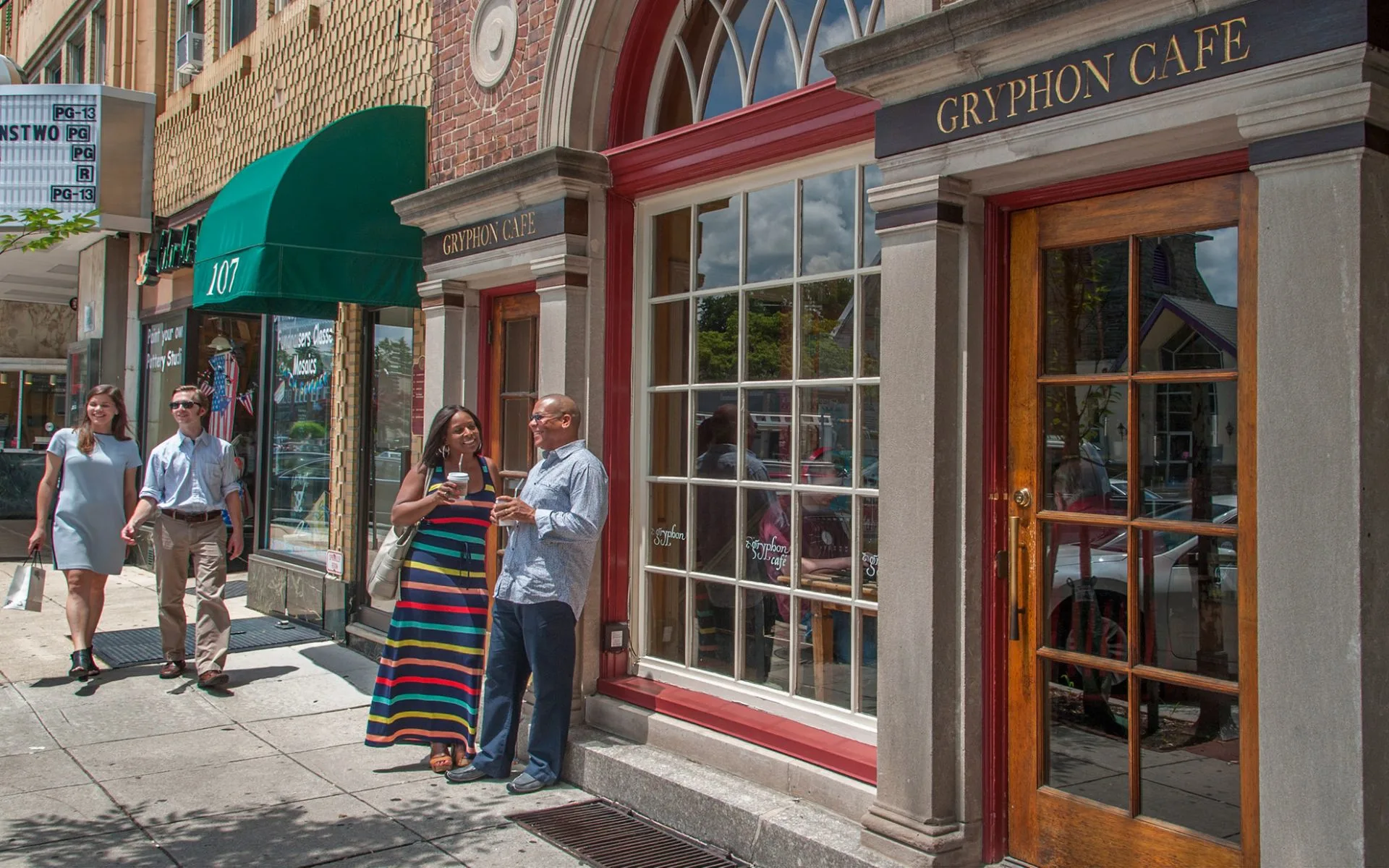
It is the place for teams that want a suburban address but still need people to arrive by train, walk to lunch, or move between meetings without a car parade.
Wayne feels more active than Radnor because the street life, station access, and retail rhythm sit closer to the business use.
That makes the district useful for meetings that need motion but not downtown noise.
Focus areas
- Keep the train access visible.
- Use the retail streets as the cue.
- Plan for walkable lunch breaks.
- Treat the district like a business town, not an office park.
Wayne — what the area looks like for events
Wayne sits in the Western Suburban Expo Corridor area.
Production for Wayne shows starts with the same brief we run for the rest of Philadelphia: venue specifics, show dates, footprint, outcome. Freight paths and local vendor availability are the variables that shift from the city core.
Philadelphia as a trade show city
The attendees vary by show — some weeks draw regional operators, others pull international buyers in for a single conference — but the floor mechanics stay consistent. Every booth needs graphics production, show services, labor calls, and a plan for the specific building it's landing in.
Philadelphia's waterfront and stadium districts add non-convention venue depth through Hilton at Penn's Landing, Rivers Casino, and Live! Casino & Hotel Philadelphia for receptions, corporate hospitality, and sponsor-facing events — a useful reference point when sizing a project.
Where Philadelphia shows actually happen
the plan has to match the specific building.
Hilton Philadelphia at Penn's Landing: 19 meeting rooms, 23,837 square feet of total event space, and a largest room setup of 7,412 square feet.
Hilton Philadelphia at Penn's Landing suits waterfront conferences, historic district room blocks, sponsor dinners, executive offsites.
Live! Casino & Hotel Philadelphia is one of the anchors.
Rivers Casino Philadelphia.
Who handles what during the Philadelphia install window
At Greater Philadelphia Expo Center at Oaks, it maintains relationships with caterers, AV, and decor partners but also states planners can bring their own caterer, which supports a flexible venue-approved model rather than one rigid labor statement.
At the Pennsylvania Convention Center, exhibitors should expect published work rules, venue-run exhibitor services, and exclusive rigging requirements. Hotels, museums, casinos, and suburban venues around Philadelphia typically route catering, AV, and event support through venue teams or approved partners.
What's included in the project scope
Projects in Wayne typically include design work, fabrication or rental sourcing, graphics production, show-service paperwork, freight, install, show-hours coverage, and strike.
Individual projects layer or remove items based on scope.
Scope boundary is as important as scope inclusion.
From first call to strike
Once scope is clear, the venue work begins.
One named show-site lead runs the install.
That document drives the next booking.
Cost and lead time
Cost scales with how it is built, how big it is, what the venue charges for its own services, what the graphics look like, how far the crates travel, and how many days the team stays on-site.
Rental programs run on 8 to 12.
Outcomes we optimize for
Trade show ROI is measured at the lead and pipeline level.
The post-show debrief is where the numbers get connected back to the physical booth. Which demo station drew traffic, which meeting area closed more conversations, which graphic zone attracted dwell time — that feedback shapes the next build rather than getting lost.
Why Trade Show Services of Philadelphia
Local fabrication means real-time problem-solving. A graphic that needs to be reprinted at 6 a.m.
Clients who run repeat programs across multiple dates end up paying less per event when the same team handles everything. Less re-briefing, less re-training, less re-checking — the operational overhead drops year over year.
Frequently asked questions
Do you work at Rivers Casino Philadelphia?
Yes.
How does labor work in Philadelphia?
It runs venue by venue.
How much lead time is ideal?
Custom builds run best with 16 to 20 weeks of lead time. Rentals take 8 to 12 weeks.
What information kicks off a project?
The show, the venue, the booth number, the dates, and a target budget range. From those, an initial scope and a realistic cost come back within a few days.
Who runs the booth on-site?
One named show-site lead runs the install, the show hours, and the strike. That person carries the floor plan and the punch list from crates to doors and reports up once a day.
Can the booth travel to the next city on our calendar?
Same structure, swappable graphics, standard crates.
What happens if something breaks during show hours?
The on-site lead handles it.